

Executive summary. Lubricants influence fuel efficiency because engines and mechanical equipment lose energy through friction and fluid movement. But not every low-viscosity oil saves fuel in every machine, and no reputable standard makes it safe to ignore the manufacturer's oil specification. The correct lubricant must balance viscous drag, boundary lubrication, wear protection, deposit control, temperature performance, oxidation stability and compatibility with emission-control components. This guide explains the science, current oil standards and a defensible method of evaluating claims.
1. Why fuel energy does not all become motion
In an internal-combustion vehicle, fuel releases chemical energy. Only a portion becomes useful work at the wheels. Energy is lost through exhaust heat, cooling, friction, engine pumping, accessories and drivetrain inefficiencies. Lubrication focuses on certain mechanical losses, but it cannot eliminate losses from combustion thermodynamics, aerodynamic drag or driving behavior. Therefore, claims that changing an oil alone will routinely cut fuel consumption by double-digit percentages require exceptional independent evidence.
Engine oil forms a film between moving surfaces and carries away heat, suspends contaminants and supports component protection. Rings move along cylinder walls, bearings support rotating shafts, and valve-train components repeatedly touch and separate under load. The lubricant must survive these varying environments. At some surfaces, a full fluid film separates the metals; elsewhere, the film becomes extremely thin and additives help protect contact regions. Different losses dominate under different temperatures, speeds and loads.
The U.S. Department of Energy's official fuel-economy guidance notes that using the manufacturer's recommended engine-oil grade can improve gasoline mileage by approximately 1–2% compared with using a less suitable, thicker grade in its illustrative comparisons. That is not a prediction for every vehicle. The same change may bring negligible benefit when the original oil already matches the recommendation, or cause harm when the replacement is outside specifications.
2. The three main lubrication regimes
Hydrodynamic lubrication occurs when relative motion creates a fluid film that substantially separates surfaces. Film thickness depends on geometry, speed, loading and lubricant viscosity. Lower viscosity can reduce some fluid shear losses, but a thinner film may increase contact risk where the engine is not designed for it.
Elastohydrodynamic lubrication is common in concentrated rolling contacts, where pressure increases viscosity and elastic deformation contributes to film formation. Some bearings, gears and cam-follower contacts may operate in this regime, depending on design and conditions. Predicting performance requires more than looking at a bottle label.
Boundary and mixed lubrication occur when fluid separation is incomplete and microscopic surface features interact. Anti-wear and friction-modifying chemistries can change behavior. Additives such as zinc dialkyldithiophosphate (ZDDP), detergents, dispersants and selected organic friction modifiers serve different roles; an additive that reduces friction under a test condition is not automatically suitable for every engine or aftertreatment system.
The famous Stribeck curve illustrates the relationship among lubrication regime, speed, viscosity, load and friction. It is a useful teaching model, not a universal curve that predicts a particular vehicle's savings. A valid production claim needs data from the relevant engine, lubricant formulation and duty cycle.
3. Understanding viscosity grades without dangerous shortcuts
SAE J300 defines automotive engine-oil viscosity classifications. A multigrade oil such as SAE 5W-30 has cold-temperature characteristics represented by its winter grade and defined viscosity requirements at higher temperatures for its second grade. The label is not a chemical-composition or oil-quality certification. Two oils with the same grade can differ substantially in oxidation resistance, volatility, detergency, additive balance and engine-test performance.
The 'W' means winter; it does not mean weight. The first number describes a set of cold-cranking and pumping requirements, not the temperature at which oil becomes universally safe to use. The second number is linked to viscosity criteria at operating-temperature test points, including kinematic and high-temperature/high-shear measurements. Consult the current SAE J300 specification for detailed boundaries and methods.
It is tempting to assume that SAE 0W-16 always beats 5W-30 on fuel economy, but the comparison is unsafe without an engine qualification. Bearings, oil pumps, oil pressure strategy, timing systems, turbochargers and service conditions may have been developed around particular grades. Some engines explicitly approve multiple grades in specified climates; others do not. The owner manual, relevant technical service instructions and specified performance category take precedence over marketing promises.
4. What current API and ILSAC standards actually mean
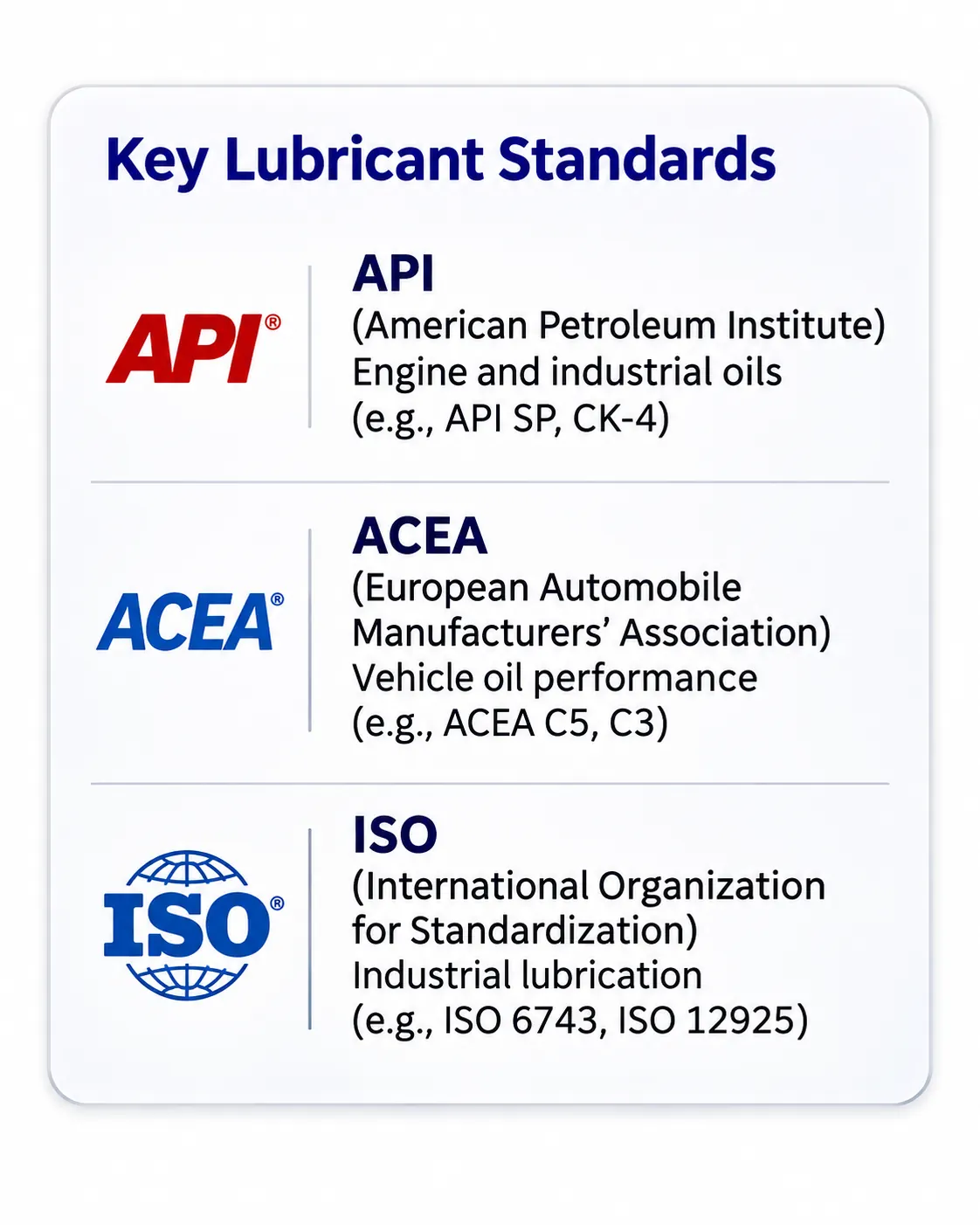
Figure: Overview of API, ACEA and ISO lubricant standards (illustrative reference graphic).
The American Petroleum Institute (API) specifies passenger-car engine-oil service categories, with API SQ introduced in March 2025. API describes SQ as addressing important protection areas including low-speed pre-ignition, timing-chain wear, piston and turbocharger deposits, sludge and varnish. API SQ carrying the additional Resource Conserving designation also incorporates specified fuel-economy and related performance requirements.
The International Lubricant Standardization and Approval Committee's ILSAC GF-7A and GF-7B were introduced in March 2025. GF-7A covers the applicable passenger-car gasoline-engine-oil grades meeting the category; GF-7B is specifically for SAE 0W-16 oils. They include requirements addressing efficiency and multiple durability concerns. They should not be treated as universal endorsements to substitute 0W-16 for an oil of another viscosity grade.
API's published motor-oil guide notes the distinction between current and historical classifications. Importers and fleet managers should verify the latest guide, current license status and vehicle-specific requirements rather than assume an old 'API SP' or 'GF-6' label is the only possible benchmark. A label on a bottle is useful only when authentic and relevant; certification claims should be verifiable using the standard owner's licensing information.
Additional standards matter for different vehicle types. Diesel oils may require particular API categories, ACEA sequences and manufacturer approvals addressing aftertreatment compatibility, soot, heavy loads and drain intervals. Transmission fluids, gear oils, hydraulic fluids and industrial lubricants each have separate test methods and approval systems. Never apply passenger-car API or ILSAC labels to infer industrial gear-oil suitability.
5. Friction, wear and longevity are linked—but not identical
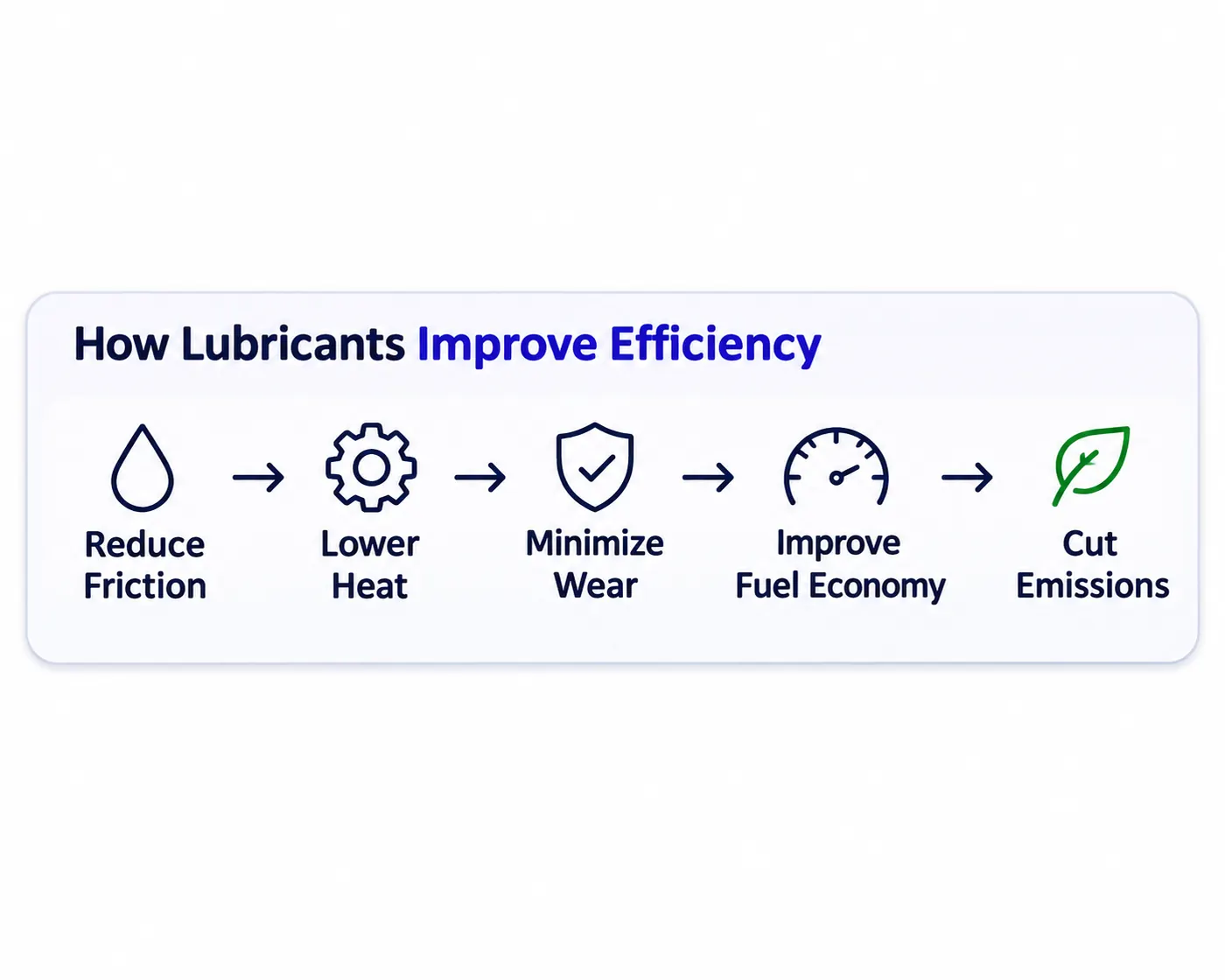
Figure: Conceptual flow from reducing friction and heat toward better mechanical efficiency; actual outcomes vary.
Reducing friction and reducing wear are not synonyms. Some chemistries may reduce measured friction without offering enough protection against scuffing or fatigue under severe loads. Conversely, a lubricant can protect equipment very well while offering limited efficiency benefit compared with another correctly selected oil. The correct purchase decision combines fuel use, wear control, deposits, maintenance cost, oil life and equipment availability.
Heat and oxidation gradually change the lubricant. Contamination with fuel, soot, water or coolant can change viscosity and additive performance. The condition of an in-service oil depends on operating environment, maintenance practices, engine state and the quality of the lubricant. Short trips, extended idling, dust, very high loads and extreme temperatures may be considered severe service by the manufacturer. Extending drain intervals without evidence is not an environmental strategy if it leads to engine damage.
Used-oil analysis can reveal trends in viscosity, certain wear metals, contamination and oxidation indicators, but it must be interpreted using the equipment's history and the laboratory's methodology. A single number rarely diagnoses an engine or justifies dramatically extended service intervals. A meaningful program tracks patterns and pairs results with inspections, operating hours and maintenance history.
6. Why additive claims deserve special scrutiny
Aftermarket oil additives are widely marketed as nanotechnology, ceramic protection, friction modifiers or engine restoration treatments. Such descriptions are not performance evidence. The finished motor oil already contains a carefully balanced additive system. Adding an unapproved product may alter compatibility, stability, foaming behavior, deposit formation or warranty terms; some manufacturers expressly discourage supplemental additives.
If a supplier claims a 10%, 15% or 25% reduction in fuel consumption, ask for a full test report including vehicle model, engine condition, reference oil, control group, repeatability, fuel properties, temperature, route or drive cycle, statistical treatment and independent verification. A demonstration without a control or a vehicle-computer readout during different driving conditions is insufficient. A lower friction coefficient in a laboratory bench test is also not interchangeable with a corresponding percentage reduction in real-world fuel consumption.
The strongest evidence is repeatable, well-controlled fuel-consumption testing on representative engines, not photographs of smoother metal or testimonials. A credible product may improve a specific property without proving a general fuel economy claim. Marketing materials should distinguish laboratory findings, field observations and verified standards-based results.
7. A realistic calculation for a vehicle fleet
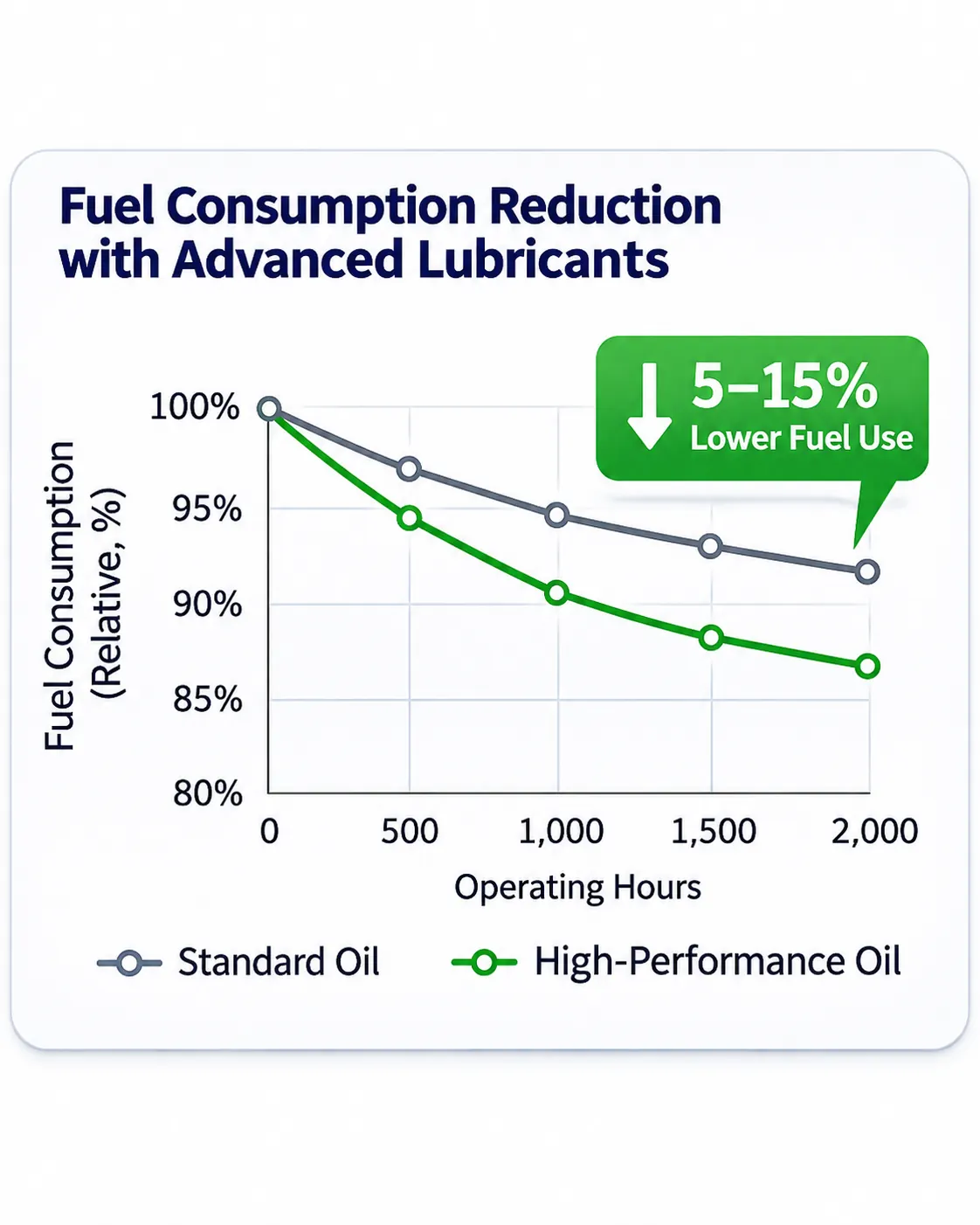
Figure: Illustrative fuel-consumption curves only. The graphic’s 5–15% claim is not established by this article and must not be presented as measured results.
Consider a hypothetical illustrative fleet, not a study result: 40 vehicles each drive 20,000 kilometers per year, with average fuel consumption of 8 liters per 100 kilometers. Annual use equals 40 × 20,000 × 8 / 100 = 64,000 liters. If controlled testing established a genuine 1% relative reduction in fuel consumed, the saving would be 640 liters per year. At a hypothetical fuel cost of $1.20 per liter, that equals $768, before lubricant-price differences, labor and other costs.
A 2% validated reduction would save 1,280 liters annually under otherwise identical conditions. These scenarios demonstrate calculation, not expected outcomes. The economics may look different for heavy-duty vehicles with much greater fuel consumption or for equipment whose reliability dominates the operating budget. The reduction must not be assumed merely because an oil is synthetic, expensive or promoted as 'fuel-saving'.
8. How to run a defensible fuel-economy trial
Start by defining a vehicle or equipment group with consistent maintenance records. Select the candidate oil only after confirming that it satisfies manufacturer requirements and relevant quality classifications. Establish a comparison method, preferably a controlled test procedure appropriate to the vehicle or fleet; for specialized heavy-duty truck tests, industry procedures such as SAE J1321 may be relevant, subject to applicability and access to the latest method.
A reliable test controls drivers, routes, payload, tire pressures, fuel formulation, weather, idling, traffic, vehicle condition and test duration wherever practical. Fuel measurements should rely on validated methods rather than dashboard fuel-consumption estimates alone. Run a sufficient number of tests to capture variability, use baseline and candidate comparisons, and report uncertainties and conditions. Do not claim statistical significance without appropriate study design and analysis.
Monitor engine health during testing. Fuel saving is not acceptable if accompanied by unsuitable wear, oil pressure problems, increased deposits or manufacturer warranty conflicts. Document oil provenance and batch identity, maintain service records and retain original lab reports. Use an independent testing organization where a public commercial claim is planned.
9. Engine oil is only one part of practical fuel management
Vehicle operators usually gain more dependable benefits from a comprehensive efficiency program than from searching for a miracle fluid. Check tires at the manufacturer's recommended pressure, maintain alignment, avoid unnecessary cargo weight and aerodynamic drag, reduce avoidable idling, address mechanical faults and plan routes. Driver training and appropriate speed management can materially affect fuel use, but improvements depend heavily on the operating context.
In industrial plants, lubrication is part of reliability-centered maintenance. Correct oil selection, filtration, contamination control, bearing condition and planned service can reduce energy losses and unplanned downtime. The value is often expressed as increased equipment availability and lower maintenance cost, not just fuel economy. A compressor, conveyor gearbox and internal-combustion engine require different lubricant considerations and should not be evaluated under a single universal percentage claim.
10. Emissions, oil life and the complete environmental picture
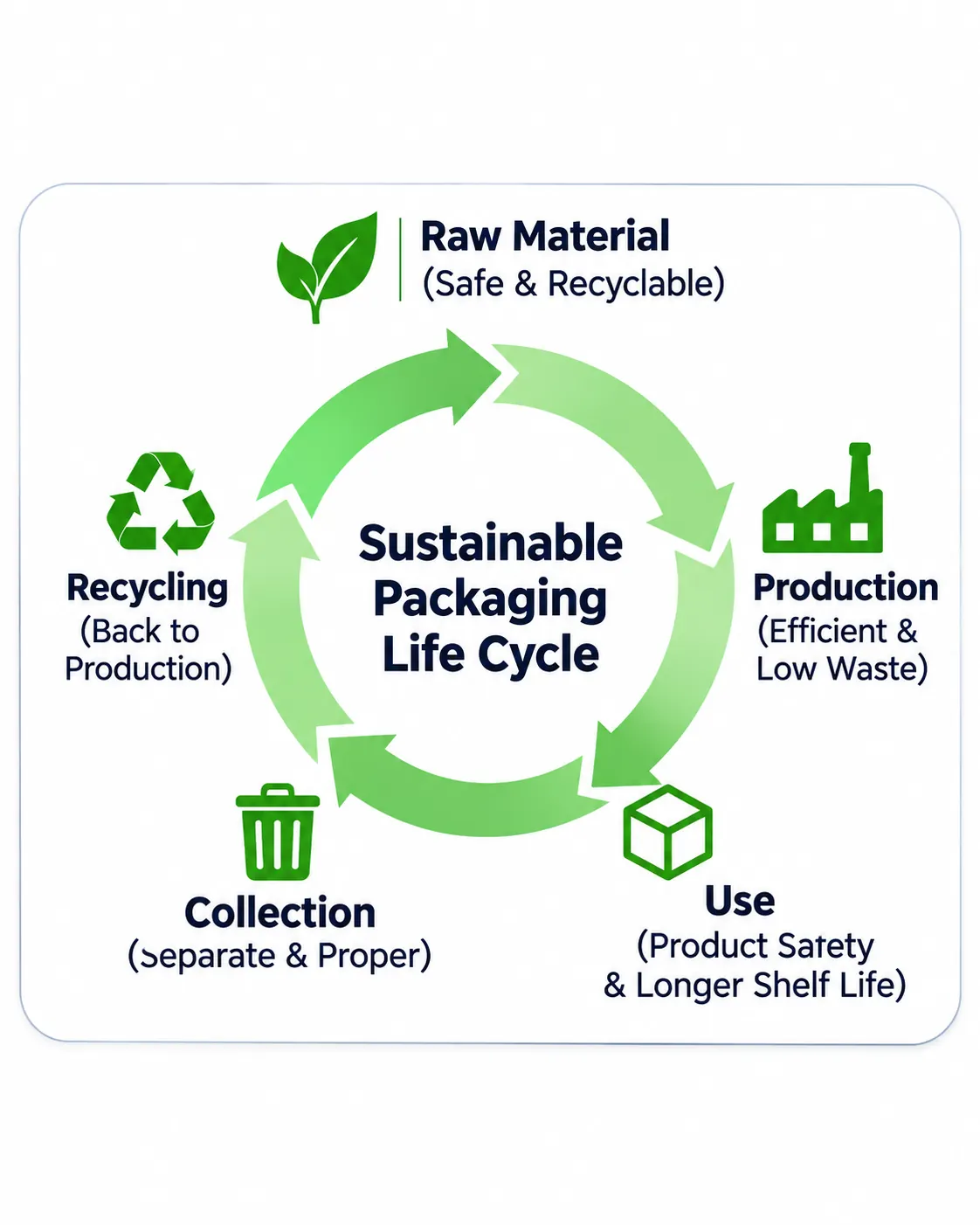
Figure: Illustration of a sustainable packaging lifecycle; not a verified lifecycle assessment.
Burning less fuel generally reduces direct combustion-related carbon dioxide emissions for the same fuel type and activity. However, overall environmental assessment should consider the lubricant supply chain, used-oil handling, component durability and maintenance. Synthetic versus conventional oil is not a complete environmental ranking without context. Some synthetic formulations offer useful cold-start or stability properties, but claims must be matched to the actual product specification and operating duty.
Used oil should be collected and handled through authorized recycling or recovery programs. Never dispose of lubricant onto soil, drains or waterways. Do not combine incompatible waste streams or contaminate used-oil storage containers with solvents and chemicals. Fleet sustainability reporting should separate measured fuel use, estimated emissions and unverified lubricant performance claims.
11. What professional buyers should check on a data sheet
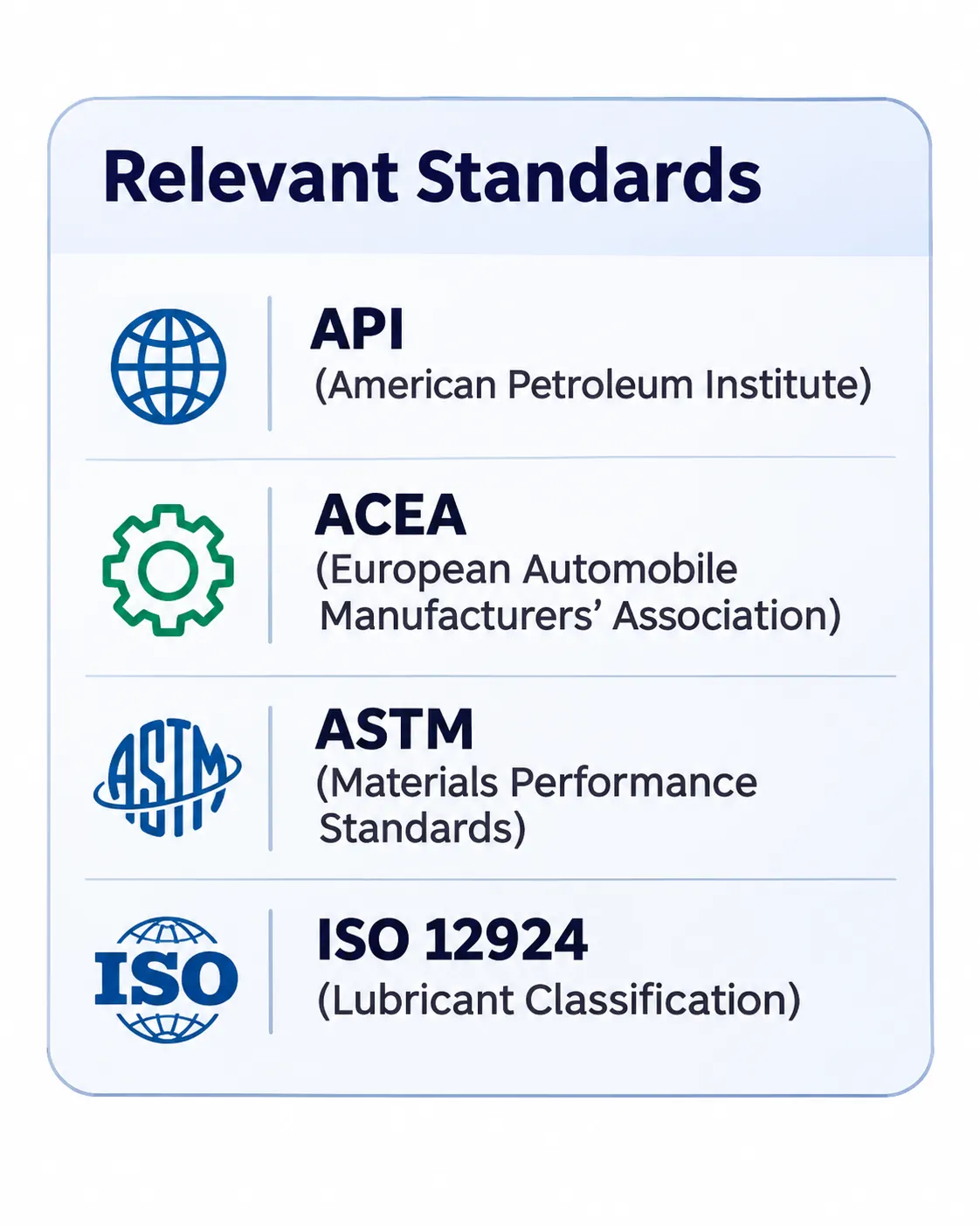
Figure: Overview of API, ACEA, ASTM and ISO references; exact applicable standards depend on the lubricant and use case.
Confirm the SAE viscosity grade where relevant, API/ILSAC/ACEA or OEM approvals actually required, test methods and batch traceability. Ask whether stated certifications are formally licensed, self-declared or based on selected tests. Request technical data including viscosity at relevant temperatures, high-temperature/high-shear performance where available, pour point, flash point and volatility where relevant. These indicators help characterize the fluid but cannot replace engine-approval requirements.
Beware of phrases such as 'suitable for all engines', 'eliminates friction', 'guaranteed 20% savings' and 'never change oil again'. These are red flags unless supported by exceptionally rigorous, relevant evidence. Different engines require different technical compromises. Good lubrication engineering begins with the application, not with the most dramatic advertisement.
12. An implementation checklist for managers
First, inventory engines, operating conditions, required grades and documented approvals. Second, identify any mismatches between existing lubricant purchasing and manufacturer specifications. Third, standardize procurement so that technicians cannot accidentally substitute a visually similar but unsuitable oil. Fourth, design a measured fuel-and-maintenance baseline. Fifth, pilot a candidate within approved limits and compare fuel use, oil condition, wear indicators and total cost. Sixth, record outcomes and re-evaluate periodically as the fleet ages or operating patterns change.
For purchasing departments, a supplier scorecard should include documentation quality, specification compliance, product authenticity, delivery reliability, batch traceability, laboratory support and transparent claims. Lowest purchase price per liter can be a poor decision metric; total operating cost is the more useful objective.
Conclusion
Lubricants matter because friction and fluid shear are real sources of energy loss. The right engine oil may contribute to fuel efficiency while protecting expensive equipment, but its effect is application-specific and typically modest in passenger vehicles when evaluated against suitable alternatives. API SQ, ILSAC GF-7 and SAE J300 provide important technical language; none overrides the manufacturer's recommendation. The most valuable lubricant program is evidence-based, documented and integrated with maintenance rather than based on unsupported additive claims.
Ardexa perspective: When evaluating lubricants or oil additives for distribution, request verifiable test evidence and carefully distinguish a product's stated function from a demonstrated fleet-level fuel reduction. Scientific accuracy is a competitive advantage, especially in B2B procurement.
Frequently asked questions
Will synthetic oil always save fuel? No. Performance depends on formulation, viscosity, engine design, operating conditions and whether the original oil met specifications.
Should I choose a thinner oil to improve mileage? Only if that grade and quality classification are approved for your engine and conditions.
Is API SQ the same as ILSAC GF-7? No. They are related performance frameworks; API SQ with Resource Conserving incorporates additional relevant requirements, while GF-7A and GF-7B have defined scopes.
Can an aftermarket oil additive guarantee fuel savings? No responsible universal guarantee follows from the additive category alone; verify controlled, relevant evidence.
What is the best fleet KPI? Track normalized actual fuel consumption together with uptime, maintenance cost and engine health, rather than isolated lubricant-cost savings.
Authoritative references
- American Petroleum Institute, Motor Oil Guide (API SQ and ILSAC GF-7): https://www.api.org/~/media/files/certification/engine-oil-diesel/publications/motor%20oil%20guide%201020.pdf
- U.S. Department of Energy / EPA, Gas Mileage Tips — Maintenance: https://www.fueleconomy.gov/feg/maintain.jsp
- SAE International, SAE J300 Engine Oil Viscosity Classification: https://www.sae.org/standards-content/j300_202405/
- SAE International, Fuel Consumption Test Procedure — Type II (SAE J1321): https://www.sae.org/search/?qt=J1321
Editorial note: All numerical fleet scenarios are illustrative. Do not connect this article to a specific oil or additive brand's efficiency claim without product-specific independent evidence and legal review.

