

Executive summary. Persian architectural tilework is one of the world's great traditions of ceramic surface design. Its visual language combines geometric construction, floral ornament, calligraphy, luminous glazes and a strong relationship between pattern and architecture. Handmade Iranian tiles remain relevant to contemporary buildings because their distinctive surfaces can bring material depth and cultural meaning to spaces. Yet claims that traditional tiles are always stronger, safer or longer-lasting than industrial porcelain are scientifically unsound. The choice depends on material composition, firing, water absorption, mechanical performance, exposure conditions and installation quality. This article brings history, design practice and materials engineering together.
1. More than a decorative surface
A tile can protect a wall from wear or moisture while providing color and texture. In Persian architecture, tiled surfaces often perform a further cultural role: they organize the experience of a courtyard, frame an entrance, connect an inscription with an architectural form or give a dome an apparent lightness that bare masonry does not possess. Repeated units turn large surfaces into a coherent composition, while variations within a handcrafted glaze create the visual richness that many contemporary designers seek.
'Persian tile' is not a single technical material. Across periods and regions, makers used different clay bodies, fritware compositions, glazes, pigments, shapes and firing methods. A mosaic assembled from small cut pieces is different from a painted square tile, an underglaze-decorated panel, a molded relief or modern studio-made tile. Each format has different production constraints and potential applications. Buyers should avoid assuming that every tile with turquoise motifs was made by the same traditional method.
The Metropolitan Museum of Art's publication Persian Tiles documents an extensive historical range. Among early examples it describes ancient glazed tile finds associated with Choga Zanbil and later architectural developments. The museum also identifies early Islamic-period uses, including turquoise-glazed features in buildings dating to the eleventh and twelfth centuries. These sources show continuity of artistic interest, not uninterrupted use of one identical manufacturing technique across thousands of years.
2. A chronological view of Iranian tilework
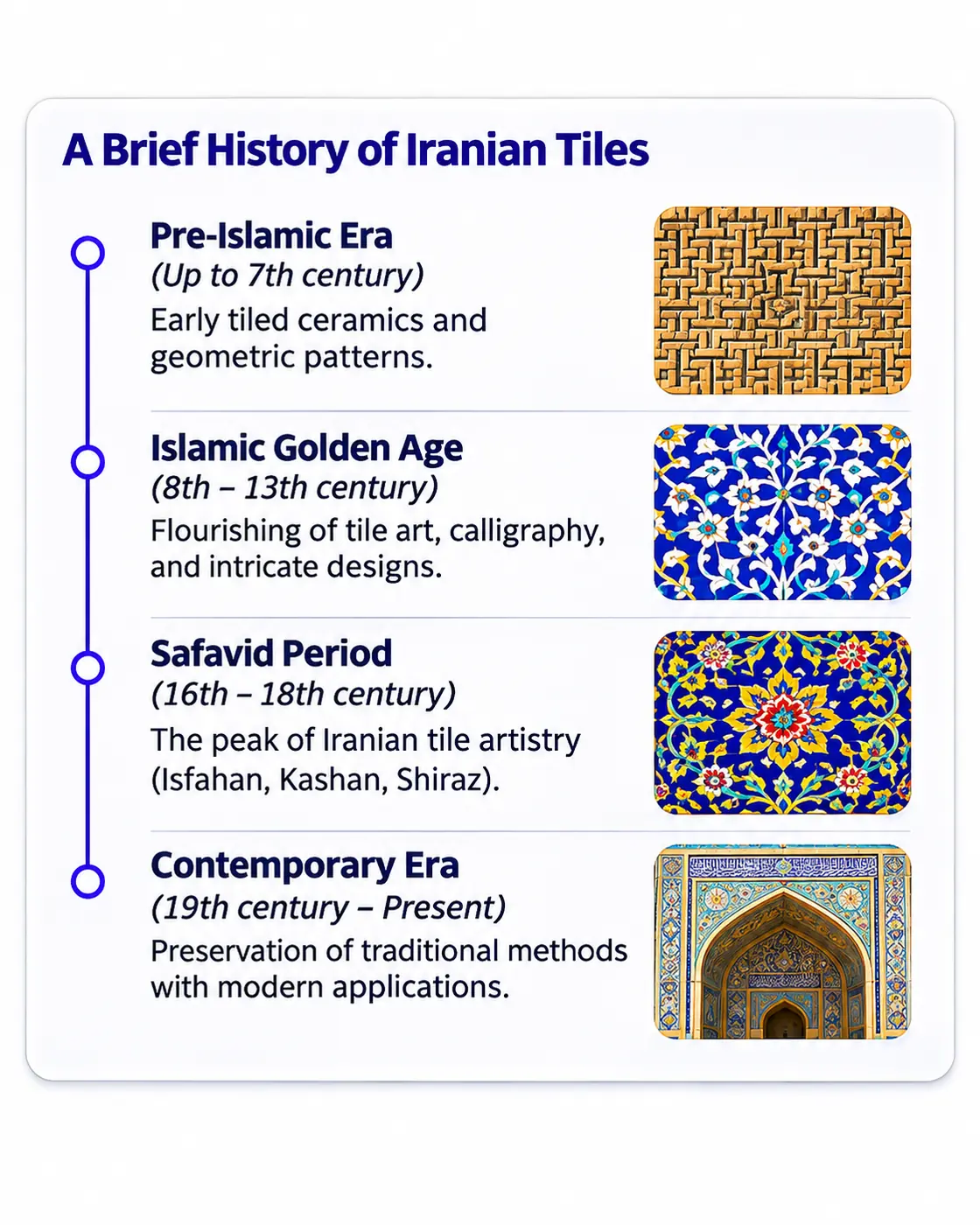
Ancient foundations. Glazed building components were known in the ancient Iranian world. Surviving material evidence reveals different uses of colored ceramic and architectural ornament, although dating, provenance and terminology require care. It is misleading to project today's haft-rang workshop practice directly into that era.
Seljuk period. Medieval Iranian architects expanded the expressive potential of brick and glazed ceramic in architectural surfaces. Turquoise details set against masonry offered strong color contrast; geometric compositions and inscriptions became increasingly sophisticated. Kashan became an important center for ceramic production, and later developments would enrich both architectural and portable ceramics.
Ilkhanid and subsequent periods. Techniques and decorative combinations developed in response to new patronage, workshops and architectural ambitions. Tile mosaics and varied ceramic surfaces allowed more elaborate colored patterns over important architectural elements. Dates and attribution should be tied to specific objects and buildings; the evolution was not a single linear invention by one artisan or dynasty.
Timurid period. Elaborate geometric and floral patterns flourished on monumental buildings in the broader Persianate cultural world. Designers exploited the relationship between fine modular patterning and large architectural surfaces. The complex geometry could visually unify gateways, domes and vertical facades while supporting differences in scale across the composition.
Safavid period. Seventeenth-century Isfahan became an extraordinary setting for architectural ceramics. UNESCO describes Meidan Emam, developed under Shah Abbas I, as an integrated urban ensemble of major monuments whose surfaces feature profuse glazed tile decoration. The Royal Mosque and Sheikh Lotfollah Mosque remain important examples of how tilework helped create a complete architectural experience. Decorative practice included mosaics and painted techniques, with production choices shaped by time, cost, pattern complexity and scale.
Modern practice. Contemporary makers produce traditional restorations, reinterpret historical motifs and develop original designs for interiors, hospitality, residential architecture and installations. Handmade production now exists alongside industrial pressing, digital decoration and high-performance porcelain. The most compelling projects often respect traditional visual grammar while specifying modern performance characteristics transparently.
3. Why the colors feel architectural rather than merely ornamental
Persian tilework frequently uses cobalt blue, turquoise, white, yellow, black and other hues in layered relationships. These colors interact with daylight, shadows, courtyards and surrounding masonry. Blue and turquoise do not have one universal symbolic meaning across every historical period, but they contribute strong visual associations with sky, water and luminous space. The physical quality of glaze matters: a reflective surface can respond differently to light than a matte, roughened or unglazed ceramic.
The aesthetic effect also depends on scale. A small handmade tile may carry a detailed vine or flower that rewards close viewing; an array of thousands of repeated pieces can become a distant geometric field. The architectural designer must therefore consider sightline, distance, lighting and pattern repetition. A dense motif that works around a doorway may overwhelm a narrow modern apartment kitchen if repeated without sufficient visual relief.
Hand production may introduce controlled variation in tone, thickness, surface, brushwork and line. Such differences can create depth and the feeling of an individually crafted object. This does not mean every irregularity is desirable. Warped edges, unstable glaze, sharp corners and uncontrolled dimensional variation can cause installation and safety problems. Craftsmanship means intentional variation within acceptable technical limits.
4. Techniques: mosaic, painted tiles and contemporary studio production
Mosaic tilework uses colored pieces cut and assembled into interlocking patterns. It requires careful geometry and labor-intensive fitting, making it well suited to detailed architectural compositions. The cost depends strongly on complexity, piece count, handling and installation.
Haft-rang, often translated as seven-color tilework, is associated with painting multiple colors and motifs onto tile surfaces rather than building every colored shape from a separately cut mosaic piece. The historical techniques and pigment systems vary, and the name should not be read as a universal chemical requirement that exactly seven pigments be present. It became especially useful for extensive polychrome decoration and figurative or floral designs.
Relief and molded ceramics add physical depth through raised elements, carving or stamped forms. They can capture strong shadows and tactile qualities, but intricate relief may be more difficult to clean and can be vulnerable where protrusions are subjected to impacts.
Contemporary handmade tiles can be formed, decorated and glazed using a variety of studio approaches. A workshop may employ modern kilns, controlled raw materials and repeatable firing schedules while retaining manual shaping and brushwork. Modern machinery does not automatically cancel artistic authenticity, just as manual execution does not guarantee sound material quality. Buyers should evaluate technique and craft documentation rather than generic labels.
5. How quality is actually measured
Ceramic tile performance is not determined solely by age, price or whether a person painted the surface. Important engineering properties include water absorption, breaking strength, abrasion resistance, stain resistance, chemical resistance, thermal-shock behavior and frost resistance where applicable. Dimensional tolerance, flatness and glaze condition also influence successful installation.
ISO 13006 classifies commercially manufactured ceramic tiles according to characteristics including forming method and water absorption. ISO 10545 contains test methods relevant to dimensions and surface quality, water absorption, strength, abrasion, frost resistance and other performance properties. The full applicability of ISO 13006 must be checked for a particular product: its scope is not a blanket certification framework for every handcrafted mosaic or nonstandard decorative accessory. Even when a handmade product falls outside a standard's direct product scope, selected laboratory test methods may still provide useful characterization if applied correctly and reported honestly.
Porcelain commonly has very low water absorption, and well-specified industrial porcelain can be highly suitable for demanding floors, wet rooms or freeze-thaw conditions. A traditional handmade wall tile with a more porous body may be excellent on a protected interior wall but unsuitable for an exposed exterior location. Conversely, a carefully engineered handmade tile may achieve strong performance for its intended use. The comparison must be between tested products, not romantic labels.
6. Handmade versus industrial: the meaningful comparison
Aesthetic uniqueness: handmade tiles often offer variation in individual brushwork, glaze and proportion. Industrial tiles are more consistent, which can be desirable for large contemporary surfaces requiring uniformity. Neither aesthetic is objectively superior.
Color and design flexibility: both approaches permit elaborate designs, but the production economics differ. Small handmade runs can support customized motifs without requiring the same volume as some factory production processes. Industrial digital printing can create extremely detailed images at scale; handcrafted work adds tactile and interpretive qualities.
Dimensional consistency: industrial pressed tiles typically allow tighter and more repeatable tolerances, subject to product class and quality control. Handmade tiles may require more flexible joint planning and installation labor. Variation should be communicated as a specification, not excused after delivery.
Mechanical performance: strong industrial porcelain often offers an advantage for high-traffic floors, while decorative handmade wall tiles may be less suited to high loads. A handmade piece should not be advertised as more durable merely because it is thicker or traditionally fired. Measurements and service conditions determine performance.
Repairability and replacement: a bespoke handmade pattern can allow individual tiles to be recreated by a capable artisan, but matching an old glaze precisely may be difficult. Industrial products may be easy to replace during active production yet become unavailable after a collection is discontinued. Extra stock and documentation help both categories.
Cost: hand painting and cutting can require many skilled hours and command a premium, especially with custom geometry. Industrial methods usually have economies of scale. Installation and waste allowances can shift the final comparison significantly.
Cultural value: a commissioned handcrafted panel can express regional motifs, a maker's identity and a direct relationship to heritage. That value is real but should not be confused with an automatically quantified technical performance advantage.
7. Longevity: what historical buildings do—and do not—prove
Centuries-old surviving tilework proves that particular ceramic objects and assemblies can endure for very long periods. It does not prove that all handmade tiles last hundreds of years or that all industrial tiles fail after a few decades. Historical survival is influenced by selection effects, climate, maintenance, repair, structural stability and the initial quality of both tile and installation. Many damaged or failed tiles are no longer visible in celebratory photographs.
Historic England identifies soluble salts, moisture and biological growth as major deterioration factors for historic architectural tiles. Salts can crystallize within porous bodies or behind glazes, potentially causing surface loss, cracking and detachment. Research published in the Journal of Cultural Heritage in 2025 examined salt weathering in antique Dutch ceramic tiles, reinforcing that ceramic durability depends on moisture transport and crystallization pathways rather than simply the date or handmade character of a tile.
Freeze-thaw exposure presents another risk where water enters pores and temperatures fluctuate below freezing. Installation systems can also fail from substrate movement, adhesive incompatibility or absent movement joints. Even an excellent tile may detach from a poorly prepared wall. For exterior or wet installations, a designer must specify appropriate tile, waterproofing, adhesive, grout, substrate and maintenance as an integrated system.
8. Choosing tiles for real projects
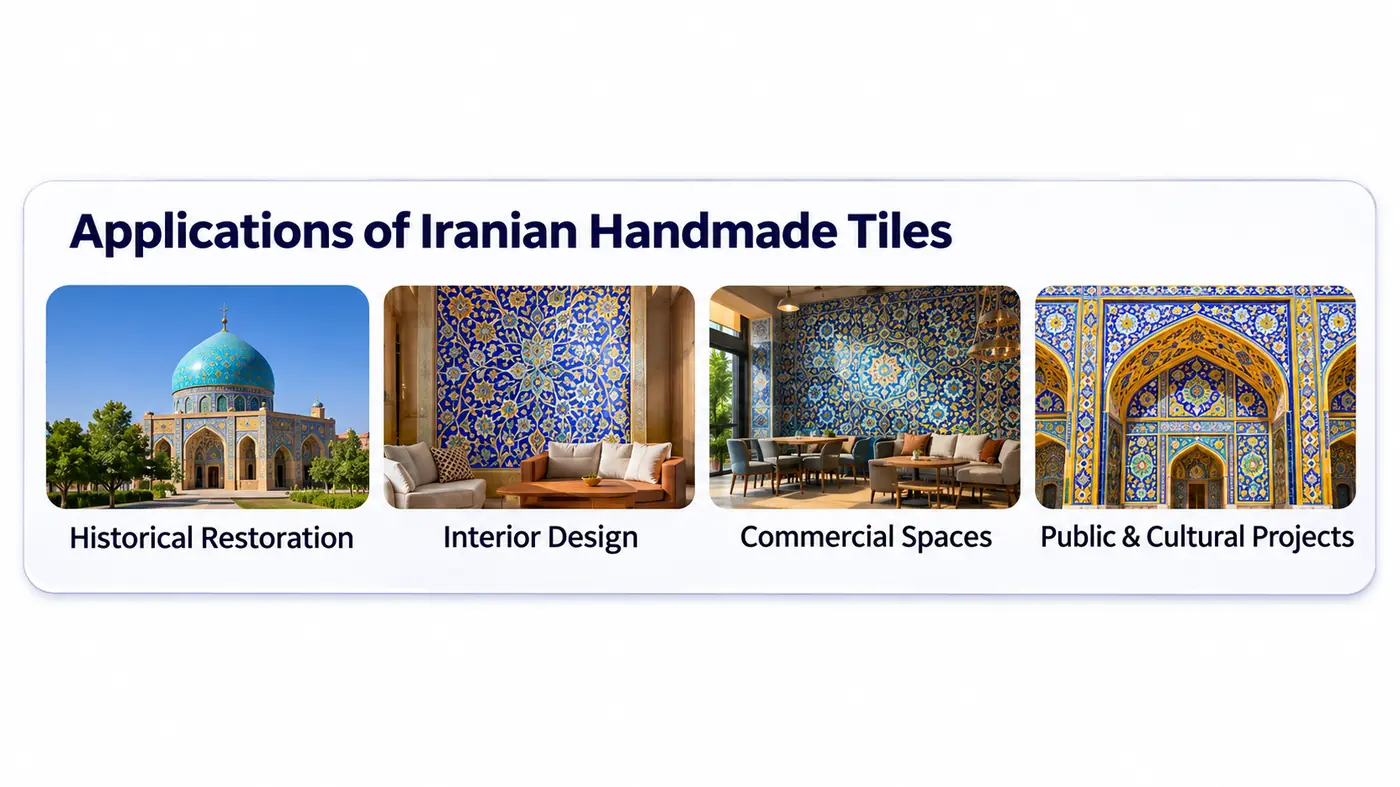
Residential feature wall: handmade Persian tiles may be ideal where close-up visual interest matters and loads are limited. Test samples in actual lighting and ensure grout lines complement the design. A protected wall application often gives designers more latitude than a shower floor.
Kitchen backsplash: assess cleanability, glaze integrity, stain resistance and resistance to household cleaning products. A highly textured or crazed glaze can demand more maintenance. Do not presume decorative pottery is appropriate for a food-preparation surface without suitable testing and hygienic considerations.
Hotel lobby or restaurant: custom panels can create a memorable identity and support storytelling. Consider visitor touch, impact potential, maintenance access and replacement stock. Use tested floor-rated materials on floors, even when the walls use more delicate handcrafted ceramics.
Exterior facade or courtyard: conduct detailed suitability checks for water absorption, freeze-thaw risk, thermal movement, sunlight, wind load, attachment methods and local building requirements. Heritage-inspired patterns can be reproduced using modern frost-resistant substrates when traditional body materials are inappropriate.
Historic restoration: conservation requires documentation, material compatibility and qualified specialist input. An indiscriminate replacement with glossy modern tiles can alter historical fabric and appearance, while aggressive cleaning can accelerate damage. Follow conservation guidance and local permissions.
Retail and commercial branding: Persian ceramic motifs can be integrated into reception walls, framed panels, furniture details and curated architectural accents. The most successful design usually avoids turning every surface into a competing focal point. Pair complex ornamental fields with quieter materials that allow the craft to remain legible.
9. Specifying and ordering handcrafted work
Begin with design intent and environmental exposure. Request physical samples, not only digital photographs: glaze reflection and color can shift under different lighting conditions. Confirm tile size range, thickness, face tolerance, acceptable color variation, edge finish and quality control process. Ask for intended-use classification and independent test reports for performance-critical installations. Obtain installation recommendations from the manufacturer and installer together.
Specify the arrangement: random mix, repeating pattern, central medallion, border or continuous mural. Prepare numbered installation drawings for complex hand-painted compositions. Include spare pieces for damage and future maintenance. Confirm batch records and approved samples. If a glaze batch changes, request a new approval rather than accepting a verbal assurance that it will match.
Ordering should include clear packaging and transport requirements. Handmade glazed surfaces need abrasion protection, appropriate separation between pieces and reliable carton labeling. Damage during international shipping can erase the value of careful workshop production. A practical purchase specification includes quality, dimensions, acceptable variation, quantities, delivery terms, documentation and a process for addressing breakages.
10. Sustainability and the cultural economy
The environmental profile of a ceramic product depends on energy used in firing, raw materials, transport, yield, installation, maintenance and service life. Handmade does not automatically mean low carbon: small kiln batches may be less energy efficient per unit, while long-lasting local production and repairability can offer advantages in particular contexts. Industrial ceramic production can be energy-intensive too, yet efficient kilns and low breakage rates can improve the results. A rigorous comparison needs product-specific lifecycle data.
The craft economy also has social and cultural dimensions. Commissions can support specialized skills, workshop livelihoods and transmission of technical knowledge. Those benefits deserve recognition, but they are distinct from laboratory-measured environmental impacts. A fair product story should explain both without pretending that cultural value itself proves a lower carbon footprint.
Responsible sourcing includes credible labor conditions, traceable materials, accurate origin information and transparent descriptions of what is hand-formed versus hand-painted. Authenticity should be described precisely. A machine-formed tile painted by hand can be genuine hand-decorated work, even though it is not fully hand-formed. Such detail strengthens trust rather than diminishing the craft.
11. An architect's practical decision framework
Start with function: wall or floor, indoor or outdoor, dry or wet, high or low traffic, restoration or new construction. Next consider the visual goal: uniform field, handcrafted variation, narrative mural or delicate geometric ornament. Then request data on water absorption, mechanical strength, chemical and stain resistance, maintenance and fitting tolerances as needed. Finally, compare total installed cost and expected maintenance, not just purchase price per square meter.
A useful hybrid strategy is to place handcrafted Persian tiles where their visual and cultural value is most noticeable, while using technically appropriate industrial materials for heavily loaded or chemically exposed surfaces. This is not a compromise of authenticity; it is design based on the distinct strengths of different products. What matters is coherence of the architecture and suitability for use.
12. Where traditional craft meets contemporary architecture
Modern architects increasingly seek materials with visible human authorship. Hand-glazed ceramic can soften stark interiors through minute variations in light and reflection. It may complement natural wood, metal, stone and concrete or create a carefully framed contrast with minimalist surroundings. Persian motifs can be translated into contemporary compositions by changing their scale, spacing, palette or orientation while preserving their underlying geometric or botanical relationships.
A thoughtfully designed wall can refer to architectural history without copying an entire historical building. For instance, a restrained band of turquoise or a modular geometric field might connect a modern lobby to Iranian craft heritage, while a custom large-scale floral panel can provide a signature feature in hospitality design. The strongest results come from collaboration among the craftsperson, architect, engineer and installer from the earliest design stage.
Conclusion
Persian handmade tilework has enduring appeal because it combines ceramic craftsmanship, architectural pattern and cultural memory. The historical examples of Isfahan show what talented artisans and architects achieved when material, pattern and space were conceived together. Modern projects can continue that tradition through deliberate and technically responsible use. Handmade ceramics do not need exaggerated claims of universal superiority to justify their value: they offer artistry, customization and historical connection, while tested industrial ceramics often provide excellent uniformity and demanding-service performance. Select each product for the environment it must withstand and the experience it should create.
Ardexa perspective: For architectural buyers seeking Iranian handcrafted tiles, a responsible offering includes a clear design proposal, workshop samples, documented technical suitability, careful export packaging and coordination with the installation team. Cultural craftsmanship and practical engineering belong in the same conversation.
Frequently asked questions
Are handmade Persian tiles always more durable? No. Durability depends on measured properties, exposure, substrate, installation and maintenance.
What is haft-rang? A Persian multicolor tile-painting tradition; the term does not require that every modern work literally use exactly seven pigments.
Can handmade tiles be used outdoors? Only when the chosen tile and complete installation system have been assessed for the project's climate and exposure conditions.
Why are handmade tiles sometimes more expensive? Labor-intensive decoration, custom designs, smaller batches and specialist installation can raise costs.
How should a designer compare handmade and porcelain? Compare aesthetics and cultural meaning separately from tested physical performance, and evaluate total installed cost.
Authoritative references
1. The Metropolitan Museum of Art, *Persian Tiles* (publication): https://resources.metmuseum.org/resources/metpublications/pdf/Persian_Tiles.pdf
2. UNESCO World Heritage Centre, *Meidan Emam, Esfahan*: https://whc.unesco.org/en/list/115
3. UNESCO World Heritage Centre, *Masjed-e Jame of Isfahan*: https://whc.unesco.org/en/list/1397
4. Historic England, *Care and Conservation of Historic Architectural Tiles*: https://historicengland.org.uk/advice/technical-advice/buildings/decorative-features/tiles/
5. International Organization for Standardization, *ISO 13006:2018 — Ceramic Tiles*: https://www.iso.org/standard/63406.html
6. Journal of Cultural Heritage (2025), *Salt weathering of antique Dutch ceramic tiles*: https://doi.org/10.1016/j.culher.2025.01.004
Editorial note: This article distinguishes cultural-historical evidence from modern materials performance. Obtain project-specific tests and specialist advice for exposed, high-load or heritage installations.

