

Executive summary. Packaging is not merely the material surrounding a product. It is a designed system that protects contents from physical damage, moisture, oxygen, light, microorganisms and contamination; enables traceability; supports logistics; and communicates essential information. Poor packaging can increase food loss, introduce chemical risks, cause production stoppages or create unnecessary waste. Conversely, well-specified packaging can improve quality and process capability while reducing total environmental burdens. This article explains how to make those improvements without confusing a recyclable label with proven sustainability, or an attractive food pack with demonstrated food-contact safety.
1. Why packaging is a systems-engineering decision
A packaging decision begins with the product rather than with a supplier's material catalogue. A dry snack that loses crispness through moisture ingress has a different barrier requirement from a fatty product sensitive to oxidation, a fragile ceramic item requiring impact protection, or a chemical product needing resistance to permeation. The manufacturer must also consider filling conditions, storage temperature, distribution time, handling practices, information requirements and the waste-management infrastructure in the destination market.
The best packaging is therefore not necessarily the lightest, cheapest or most visually distinctive option. It is the least resource-intensive adequate system over the relevant life cycle. Reducing material thickness without testing seal strength or transit performance can cause leaks and product losses that outweigh the material savings. Overspecification creates its own cost through excess film, carton volume, transport weight and disposal. Optimization means balancing these effects with measured evidence rather than slogans.
ISO 18601 provides the general framework for the ISO packaging-and-environment series, while ISO 18602 covers optimization of packaging material weight or volume consistent with packaging functions. ISO 18603 addresses reuse and ISO 18604 addresses material recycling. None of these is an automatic certification that every real-world waste system can recover a particular pack. A technical assessment must consider actual collection, sorting and processing pathways in the relevant geography.
2. The first priority: protecting human health
Food-contact materials can transfer substances to foods and beverages. This phenomenon, called migration, depends on material composition, manufacturing conditions, the type of food, contact duration, temperature and the surface-area-to-volume relationship. A material suitable for short contact with dry goods may not be suitable for hot-fill acidic beverages or oily foods. Safety cannot be inferred from appearance, color, a recycling symbol or a generic declaration that plastic is 'food-grade'.
The European Food Safety Authority (EFSA) explains that its scientists examine migration and toxicological data when evaluating the health risks of food-contact materials. The European regulatory framework includes Regulation (EC) No 1935/2004 and good manufacturing practice rules under Regulation (EC) No 2023/2006; plastic food-contact materials have additional requirements under Regulation (EU) No 10/2011, as amended. These rules are relevant when manufacturing or placing applicable products on the EU market. Requirements vary elsewhere and must be mapped country by country.
For procurement, demand an appropriate declaration of compliance where legally required, the identity of the intended contact layer, applicable migration testing conditions, documented raw-material traceability and information on inks, adhesives and recycled content. Printing should be positioned and processed so that substances do not migrate into food at unsafe levels, including through set-off in wound reels. Changing an adhesive, ink, recycled resin source or processing temperature can trigger the need for a fresh risk assessment.
Human health considerations also cover workers. Packaging factories use heated sealing jaws, moving rollers, cutting equipment, solvents, adhesives and cleaning chemicals. Engineers should establish machine guarding, ventilation where needed, lockout procedures, operator training, occupational exposure controls and safe chemical storage. A hygienic product design does not compensate for unsafe production conditions.
3. Understanding environmental impact beyond the recycling logo
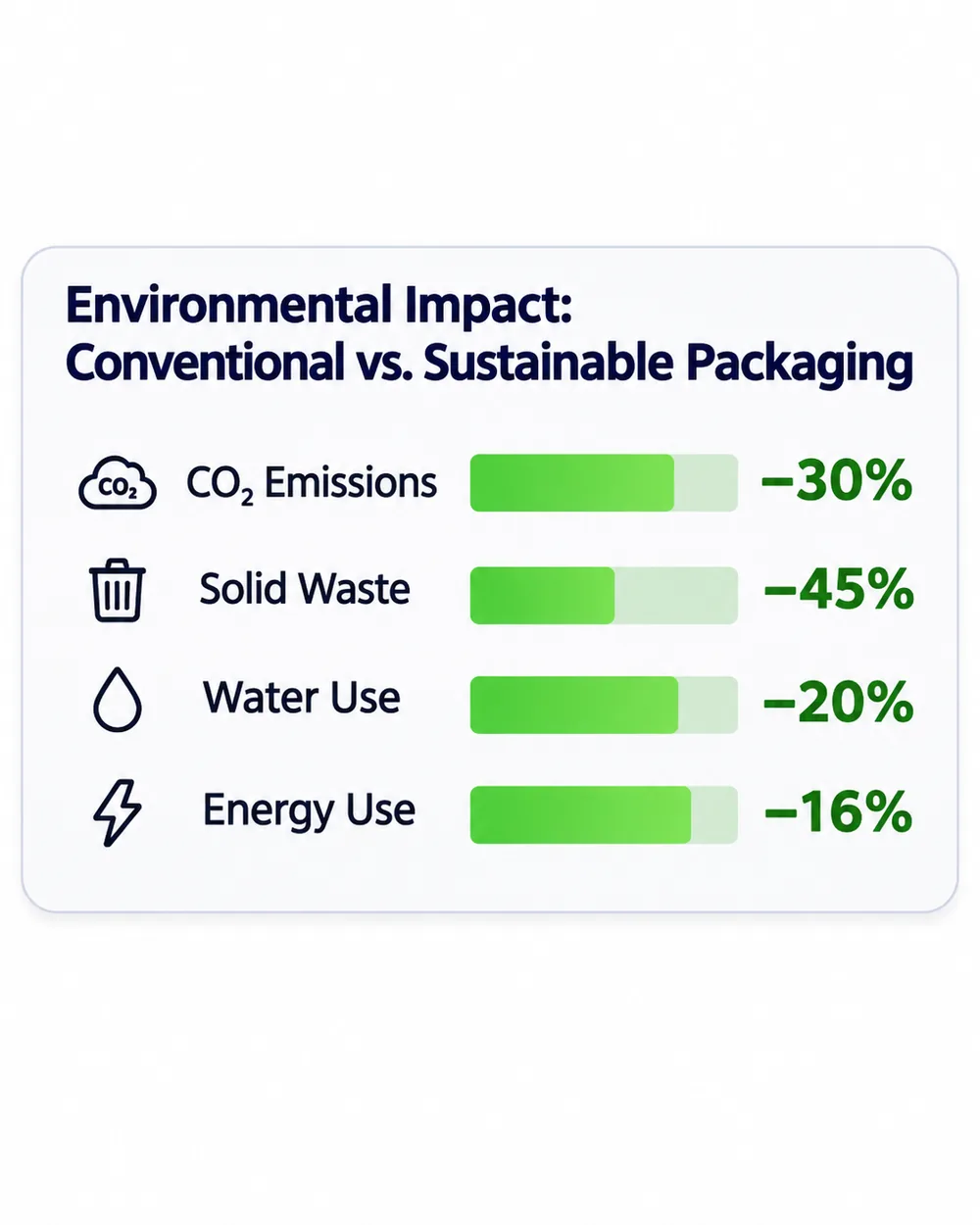
Packaging environmental impacts occur before a product reaches the customer and continue after it is discarded. Raw-material extraction, resin or paper production, converting, printing, transport, cooling and disposal can all matter. The relevant evaluation method is a life-cycle assessment (LCA), defined around a functional unit such as delivering 1,000 saleable units in safe condition to customers. Without a functional unit, comparisons can mislead: a lighter pack may generate more spoilage, while a heavier reusable container might perform well only after enough successful reuse cycles.
A useful design hierarchy begins with avoiding unnecessary packaging, then right-sizing the necessary pack, considering reuse where effective, and choosing recovery-compatible designs where the local system supports them. Recycling is valuable, but recycling potential is not proof of actual recycling. Multilayer films can deliver excellent barrier performance yet be difficult to separate in conventional recycling streams. Conversely, switching to mono-material structures may simplify recovery but requires new testing of sealing and barrier properties.
The EU Packaging and Packaging Waste Regulation, Regulation (EU) 2025/40, entered into force in February 2025 and has applied generally since 12 August 2026, subject to particular transition schedules and provisions. It introduces measures on packaging minimization, substances of concern, recyclability and other circular-economy objectives. Businesses targeting EU markets should identify the precise obligations applicable to their packaging format, organization and date, rather than assuming a single rule applies identically to every product. The European Commission also publishes implementation guidance and updates.
Environmental claims must be specific. 'Made with 30% recycled plastic' is a measurable statement if supported by a credible accounting and verification method; '100% sustainable' is too broad to be informative. Compostable packaging should not be described as naturally degradable in every environment. Industrial compostability, home compostability and marine biodegradation are different concepts requiring different evidence and collection conditions.
4. How packaging affects manufacturing productivity
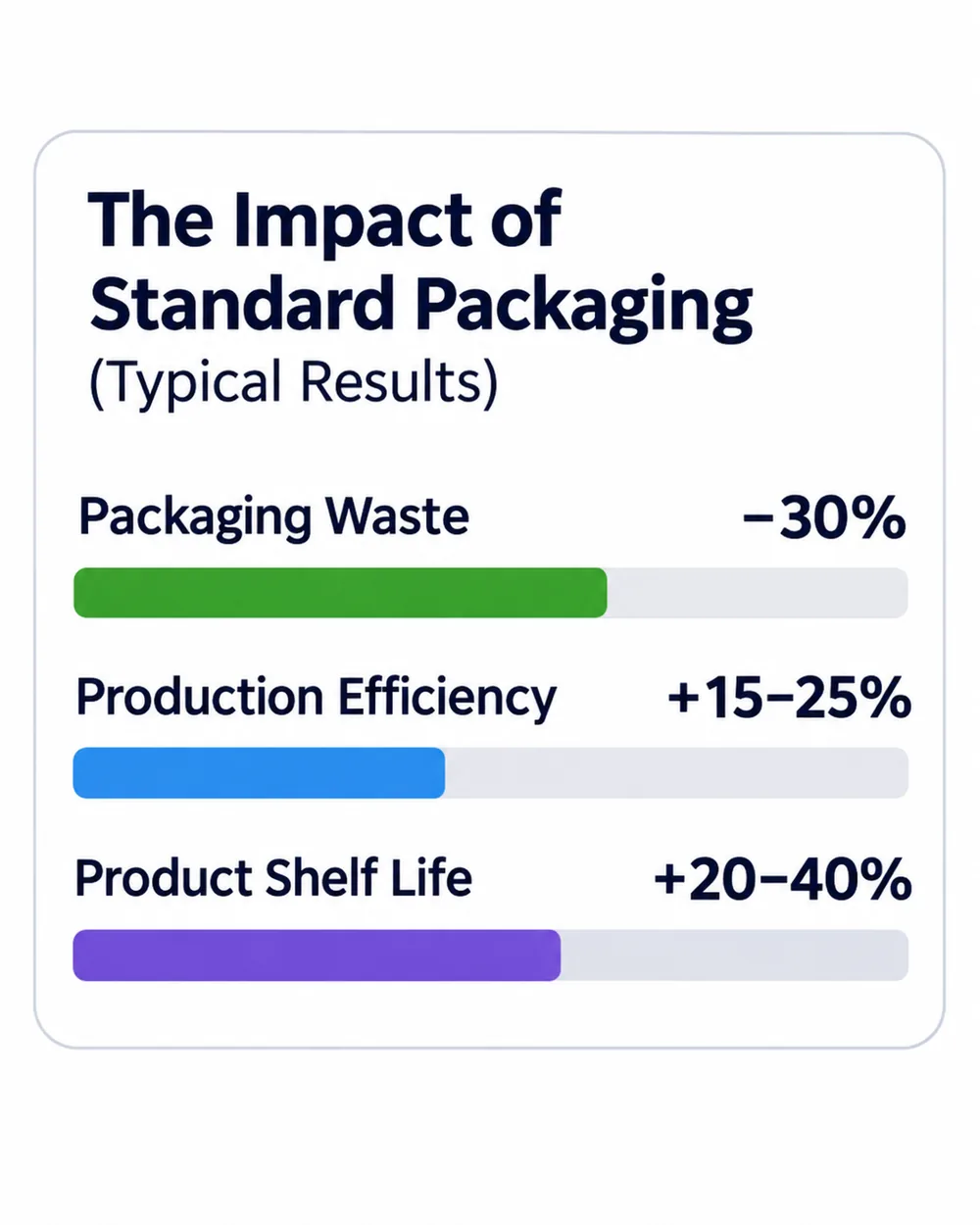
Packaging material variability can reduce the output of an otherwise well-designed filling line. In flexible packaging, film thickness variation, coefficient of friction, tension stability, flatness, curl and sealing behavior affect machine speed, registration accuracy, jaw contamination and scrap. A supplier who delivers a consistent film roll may save more money than a lower-priced supplier whose material causes frequent stoppages.
For a quantitative starting point, measure Overall Equipment Effectiveness (OEE) as availability × performance × quality. Availability captures downtime, performance compares actual running speed to a meaningful ideal speed, and quality measures good output divided by total output. OEE is a diagnostic metric, not an independent proof of packaging quality. If a film causes a 30-minute jam each shift, the problem may appear under availability; if operators reduce speed to prevent seal defects, it appears under performance; and rejected packs appear under quality.
A robust packaging specification should include tolerances for width, thickness, roll diameter and winding direction; mechanical properties; seal initiation and strength requirements; barrier parameters where necessary; print registration; and defined acceptance testing. Material specifications must be tied to the filling line and to product shelf-life requirements. The specification should also state what constitutes a nonconformity and who decides release, quarantine or rejection.
Worked example: where cost savings really come from
Consider a hypothetical, not measured, factory packing 100,000 units each week. Each package consumes $0.08 of material and 4% are rejected due to seals, printing or handling. The factory makes a process improvement that reduces the reject rate to 2%, while using the same material cost per pack. Material losses attributable to those rejects fall from $320 to $160 for every 100,000 attempted packs. This simple $160 difference excludes energy, labor, rework, disposal and downstream product value, so it is not a full profitability analysis. It nevertheless illustrates why process consistency matters even when the nominal pack price does not change.
For decisions involving product damage or food spoilage, compare the value of protected contents and any recall risk as well as material cost. The package should be designed to preserve the delivered acceptable product, not merely minimize cost per empty pouch.
5. Product protection and shelf life
Packaging engineers commonly evaluate oxygen transmission rate (OTR), water-vapor transmission rate (WVTR), seal strength, puncture resistance and package integrity. Tests must be performed at appropriate environmental conditions because moisture and temperature may substantially change barrier performance. For high-risk foods, challenge or shelf-life studies may also need microbiological and sensory analysis. Packaging can preserve suitable quality for longer, but it cannot make contaminated food safe or replace safe manufacturing controls.
A shelf-life study should specify initial product quality; relevant deterioration mechanisms; likely distribution temperatures and humidity; proposed packaging structures; sampling intervals; and objective failure criteria. Time-to-failure should not be extrapolated casually from a single accelerated test. The packaging, product formulation and distribution system interact, so changing the film may require new shelf-life validation.
6. Design for recyclability, reuse and practical collection
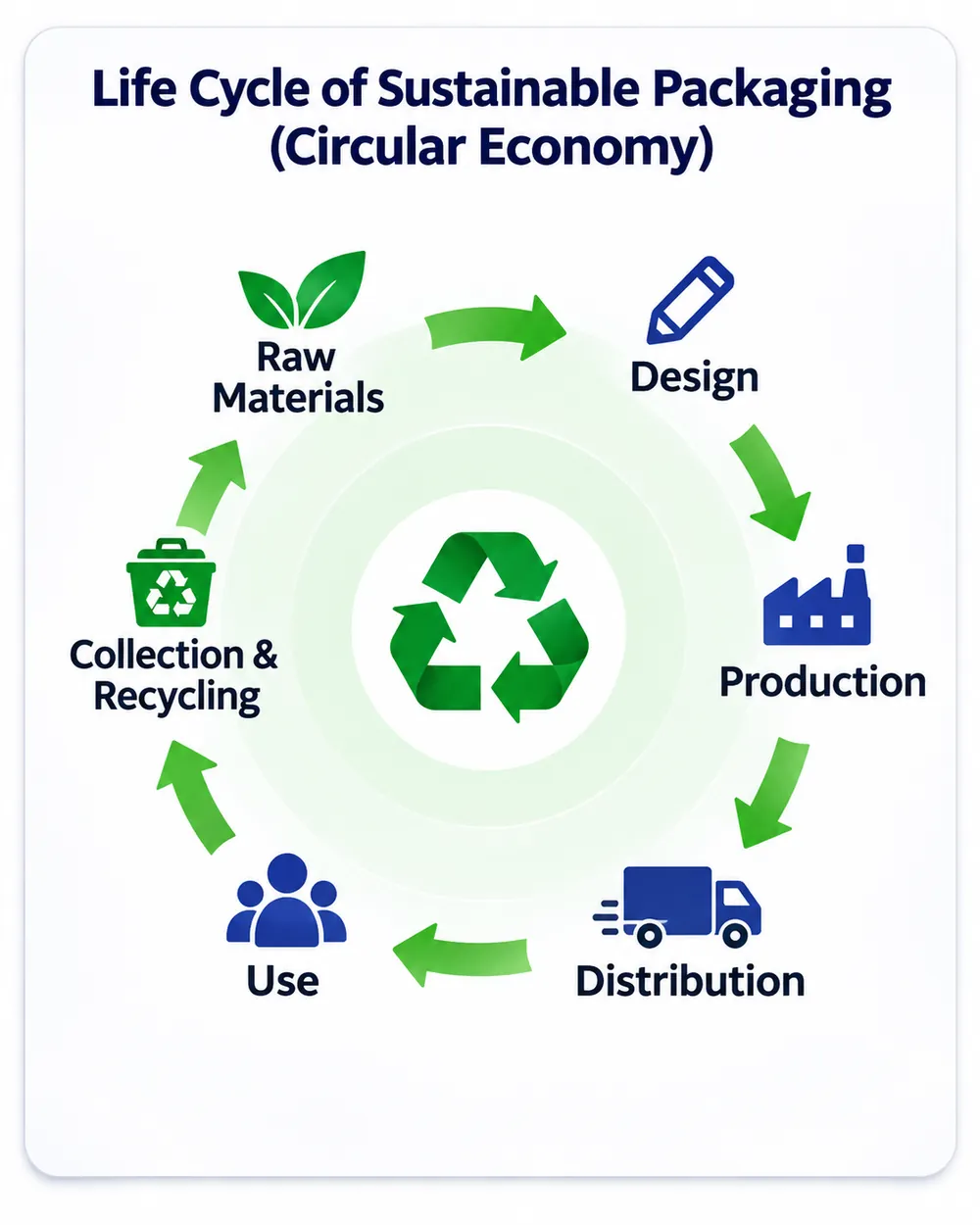
Design teams should consult recyclers and producer-responsibility schemes early. The decisive questions are whether the package will be collected, whether sorting systems can identify it, whether contamination and labels compromise processing, and whether a market exists for the recovered material. A potentially recyclable polymer is insufficient if the final pack combines incompatible layers, difficult pigments or nonremovable attachments.
Reusable packaging requires a different business calculation. Returned totes and crates may avoid disposable packaging over multiple trips, but washing, reverse logistics, breakage, empty return transport and product contamination must be considered. Establish minimum expected reuse cycles and track loss rates. If return rates are low, theoretical advantages can disappear.
Primary, secondary and tertiary packaging should be optimized together. A modest increase in primary-pack integrity might allow less secondary cushioning; improved pallet patterns may reduce transport space without sacrificing stability. Real improvements are usually discovered through cross-functional trials, not by treating each packaging component in isolation.
7. Procurement and quality assurance: a practical checklist
Before approving a new supplier or structure, build a documented risk file: intended product and contact conditions; geographical market; material composition; applicable legislation; supplier declarations and test reports; dimensional tolerances; seal and barrier requirements; printing/adhesive specifications; product shelf-life evidence; transport validation; waste-management assumptions; cost scenarios; and contingency supplies. Assign owners and review dates rather than storing documents in an unmaintained folder.
At incoming inspection, use risk-based sampling for key characteristics and retain traceability to material lot numbers. During production, set monitored process windows for sealing temperature, pressure, dwell time, line speed and tension as relevant. Where appropriate, install visual inspection, checkweighing, leak checks and rejection verification. When a defect is detected, investigate the systemic cause: changing temperature without checking contaminated seal areas or film mismatch can hide the real problem.
The packaging supplier and customer should agree on a change-control process. Resin grade, recycled-content level, additive package, thickness and film-layer structure are material changes, not merely procurement substitutions. Pilot validation before a full commercial run is typically less expensive than discovering incompatibility after thousands of packs have been produced.
8. Six metrics worth tracking every month
Material intensity: grams of packaging used per saleable product, with product protection held constant. Reject rate: rejected packaging or packages as a percentage of total attempts. Unplanned downtime: minutes lost by cause, particularly packaging feed and sealing faults. Customer damage or complaint rate: incidents normalized to shipped units. Verified recovery performance: collection and recovery outcome in the target market, not generic material claims. Total packaging cost per good unit: materials, loss, labor, energy, rework, logistics and disposal divided by acceptable delivered output.
The best improvement program combines these measures rather than maximizing just one. Material reduction that doubles complaints is not a success; a high-speed line with leaking seals is not productive; a recyclable label with no collection pathway does not demonstrate circularity.
9. A 90-day improvement plan
Days 1–30: establish the baseline. Map product risks, identify packaging constructions, review food-contact documentation where relevant, collect scrap and downtime data, and interview maintenance, quality and operators. Rank problems by cost, safety and frequency. Select no more than two pilot formats so the work remains manageable.
Days 31–60: test alternatives. Define measurable acceptance criteria; qualify new films or formats; conduct controlled filling trials; test seals, package integrity and critical barrier properties; and compare total costs and environmental indicators under equal functional conditions. Document what changed and what did not.
Days 61–90: validate and standardize. Perform a larger validation run, review transport and shelf-life implications, update standard operating procedures, train line operators and lock down the approved specification. Track the same KPIs for several production cycles. Scale only when safety, quality and performance gates have been met.
10. What buyers should ask a packaging partner
Ask for evidence rather than generic promises. Can the supplier explain why the proposed structure is suitable for the product? Can they show production tolerances, compliant food-contact documentation where required, migration and barrier test conditions, batch traceability and change-control rules? Can they help measure reel performance and waste on your actual machine? Can they discuss realistic collection and recovery routes in the country where the product is sold? Can they distinguish a preliminary estimate from a verified result?
In a competitive manufacturing environment, reliability creates commercial value. Consistent packaging can reduce customer complaints, improve on-time delivery, protect the brand and simplify factory planning. A lower environmental footprint is most credible when demonstrated alongside product protection and efficient production.
Conclusion
Standardized packaging sits at the intersection of consumer safety, sustainable materials management and industrial productivity. Its value comes from disciplined design: understand the product, verify contact safety where relevant, optimize materials without weakening protection, validate machine performance and evaluate the entire packaging system. The result is not simply a better-looking package. It is a more dependable and auditable manufacturing and distribution process.
Ardexa perspective: Companies selecting packaging films, branded product packaging or packaging-related production solutions should begin with documented product requirements and measurable trials, rather than marketing claims about any one material.
Frequently asked questions
Does recyclable mean environmentally best? No. Compare the complete packaging-and-product system using an appropriate life-cycle perspective, including actual collection and recycling conditions.
Is every plastic package safe for food? No. Food-contact suitability depends on composition, conditions of use and applicable compliance evidence.
Can thinner packaging improve sustainability? Sometimes, if the pack still meets protection, production and transport requirements.
Does ISO 18602 certify food-contact safety? No. It addresses environmental optimization of packaging, not the full legal framework governing migration into food.
Can packaging improve production efficiency? Yes, when stable dimensions, machine-compatible surfaces and consistent seals reduce stoppages, speed losses and rejected units; improvements must be measured on the actual line.
Authoritative references
- European Food Safety Authority (EFSA), Food Contact Materials: https://www.efsa.europa.eu/en/topics/topic/food-contact-materials
- European Commission, Packaging Waste and Regulation (EU) 2025/40: https://environment.ec.europa.eu/topics/waste-and-recycling/packaging-waste_en
- European Commission, PPWR implementation guidance: https://green-forum.ec.europa.eu/green-business/packaging-and-packaging-waste-regulation-implementation_en
- International Organization for Standardization, ISO 18601:2013: https://www.iso.org/standard/55869.html
- International Organization for Standardization, ISO 18602:2013: https://www.iso.org/standard/55870.html
- International Organization for Standardization, ISO 18604:2013: https://www.iso.org/standard/55872.html
Editorial note: Legal obligations depend on market, product and implementation dates. Technical claims and compliance language should be reviewed against the final product specification before publication or sales use.

